
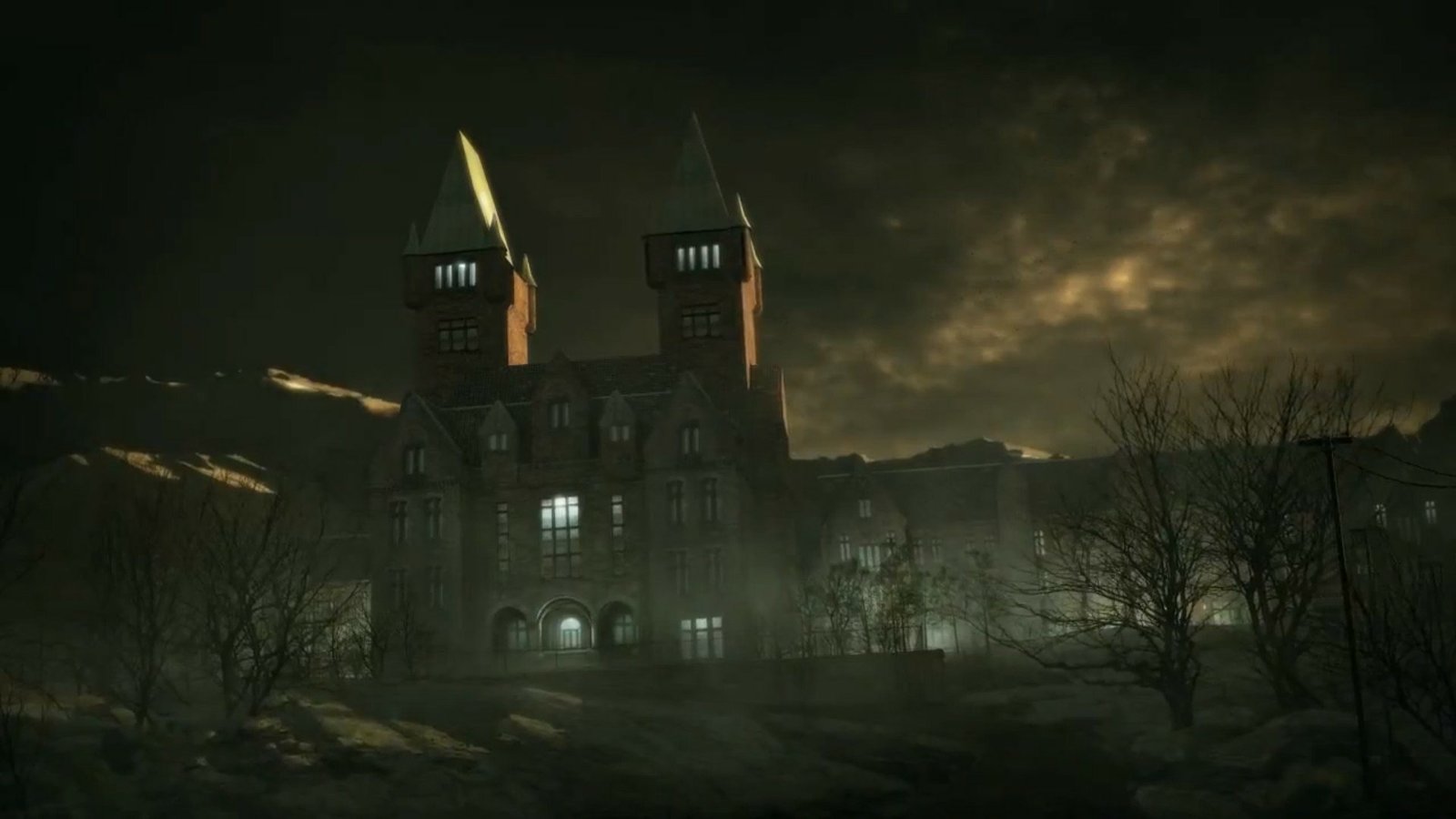
Let’s play Family Feud. Poll 100 people on the scariest game they’ve ever played. What’s on the board? Surely a Silent Hill, and a Resident Evil, too. Alien Isolation seems likely. One name I’m certain makes it on the board is Outlast.
The horror game from Montreal-based indie studio Red Barrels was released in 2013 as the debut effort from what was then a 10-person team. The studio was founded by developers who left roles at big-budget studios like Electronic Arts, Ubisoft, and Naughty Dog to pursue something they could call their own.
Content warning: This article contains descriptions of extreme violence.
“After our project got canceled at EA, we were having a hard time picking up on where we would want to go, what we would want to do,” co-founder Phillipe Morin said. “And so I think that’s when we realized that we were pretty much all at the same place career-wise [and felt] it was time we try to make a project of our own.”
Morin said the team didn’t know what its first game would be, but they landed on a horror game because that’s what they were passionate about, with a distinct style to stand out: first-person, defenseless in nature–players could only run and hide from enemies, not fight back–with what would become the game’s signature night-vision lens coloring the terror lurking around every corner.
The co-founders figured Frictional Games’ success with Amnesia: The Dark Descent proved there actually was a viable market for horror games. Morin recalled how quickly their expectations unraveled. “We thought at first that we’d come up with the pitch within three or four months and shop it around to a few publishers, and we’d find out pretty quickly if it works or not,” he said. Instead, it took 18 months of meetings.
Partners were hard to come by; publishers were still obsessed with mobile games. Morin remembered potential partners telling him that they’d “rather invest $50,000 in 10 mobile games than $500,000 in [Outlast].” Ultimately, the Canada Media Fund (CMF) helped bring Outlast to fruition. But a million dollars from the CMF wouldn’t be enough. Morin told me the group put forward an additional $360,000 from their own savings accounts and credit cards, and leveraged their home mortgages to see the project through to the end.
“Everything was pretty much on the line,” he reminisced. “Of course, it meant working very long, long hours. We were in a sprint to release the game before running out of money.”
No publisher materialized, but the work continued. Red Barrels eventually felt it could get the game to the finish line on its own. “We were experienced game developers,” Morin explained, “but we didn’t know much about that side–publishing and marketing and sales and all that. So we had to learn on the fly.”
A familiar name would come to Red Barrels’ aid: Amnesia. Some folks at Red Barrels sat in on a conference talk by Frictional Games co-founder Thomas Grip, who said Frictional sold 400,000 copies of Amnesia in its first year on Steam. Red Barrels adopted that same total as its goal for Outlast.
The game’s first discount event, timed for Halloween that year, proved successful, though Morin also recounted the boon of being featured on Conan O’Brien’s Clueless Gamer segment. Five months after launching the game, Outlast had hit its year-one goal of 400,000 copies sold. Around the same time, Outlast was ported to PlayStation 4 and included in its popular PlayStation Plus subscription at launch, which gave its brand another big boost.
But playing Outlast, or working on it, isn’t for everyone. Even for players who consider themselves horror enthusiasts, the games are intense not only because players have no way to fight back, but also because of how far they go in their depictions of violence.
Talking with Morin, I was finally able to ask something that was on my mind for years: Was Outlast a reaction to the so-called “torture porn” trend in horror movies of the time, such as Saw and Hostel? He told me it actually wasn’t so calculated. Perhaps concerningly, it was simply a “personal preference.”
“We didn’t start like, ‘Oh, we’ve got to make the goriest game out there.’ It was just, ‘We’re making a horror game, so obviously we’ll make it gory.’ I remember even the scriptwriter early on was saying, ‘There’s never too much blood.'”
This degree of violence should mean Outlast is forever niche, but it’s been one of its biggest selling points, helping it become a household name among horror fans. “I remember there was a playtest, and somebody, after a couple of hours, basically ran out of the studio to go cry outside,” Morin recalled, saying that she never came back.
By the end of 2017, Red Barrels confirmed it wanted to do Outlast 3 eventually but noted that it had shifted focus to a new project. That would become Red Barrels’ biggest project ever–in both scope and success: The Outlast Trials.
Playable solo but intended as a co-op game for up to four players, The Outlast Trials was a reaction to the way many players were already playing Outlast. “We knew that there were a lot of people playing the [earlier] games, but within a group,” Morin explained. “What if we can create that kind of experience, but everybody has a controller?”
It would be six years between that seed of an idea and the early-access launch of The Outlast Trials in 2023, during which the team grew to 45 people. Today, it’s the best-selling and most-played Outlast game in the series, with nearly 19 million lifetime players.
Collectively, the Outlast series has attracted more than 60 million players. I asked the co-founder whether that type of success makes getting back to Outlast 3 easier, or more difficult. “Previously, we said that Outlast 3–we wanted to make it at some point. I don’t think we’ve announced anything more official than that.”
Fifteen years ago, Red Barrels couldn’t find one company willing to publish Outlast. Today, the series is part of a distinct chapter in horror game history. Just as Silent Hill and Resident Evil inspired so many games that look and play like them, Outlast helped usher in a wave of horror games where players must run from relentless monsters, unable to fight back.
About the Author




1 thought on “How Outlast Went From Near-Rejection to 60 Million Players”